Transaction Systems
Decision Design
Empowering the $14M Decision: T. Rowe Price’s First Digital Distribution Experience
PRODUCT IMPACT
91% reduction in transaction cost
28% increase in customer satisfaction
68% reduction in operational inefficiencies
Company
T. ROWE PRice
 U.S. asset manager serving millions of investors and retirement plan participants.
Background

T. Rowe Price managed retirement distributions entirely on paper — a $14M annual process. Users had to call a representative tasked with explaining implications and encouraging reconsideration.

But distributions are highly considered decisions. By the time users called, they had already made up their minds. The model created friction for users trying to proceed and put representatives in the position of working against user intent.

T. Rowe Price recognized that this model was costly — both operationally and experientially. Moving distributions online offered an opportunity to reduce costs, respect user autonomy, and shift the experience from persuasion to informed decision-making.

Terminated participants — those leaving employer-sponsored plans — accounted for 60% of total distribution costs, making them the natural starting point for the first online MVP.

What began as a cost-reduction initiative became an opportunity to redefine how a retirement institution supports participants at one of the most financially significant moments of their lives.

Strategic Opportunity

MY ROle

Lead UX Designer and the sole T. Rowe Price designer on the project, responsible for end-to-end design strategy and execution of the first online retirement distribution experience — delivered from concept to launch in four months.

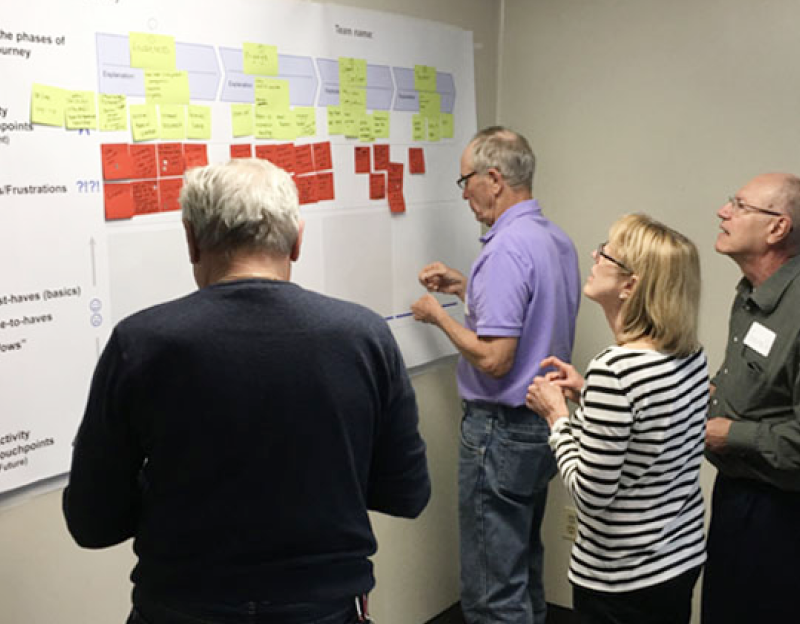
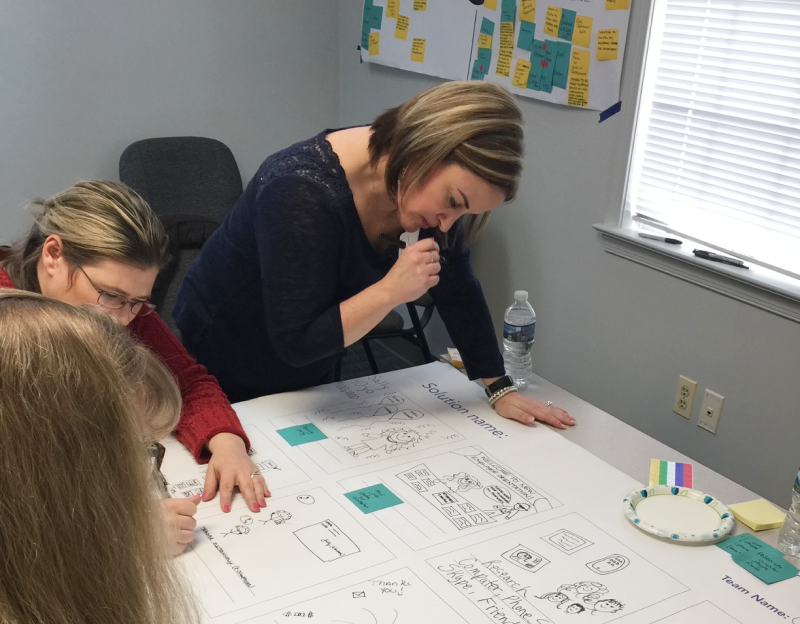
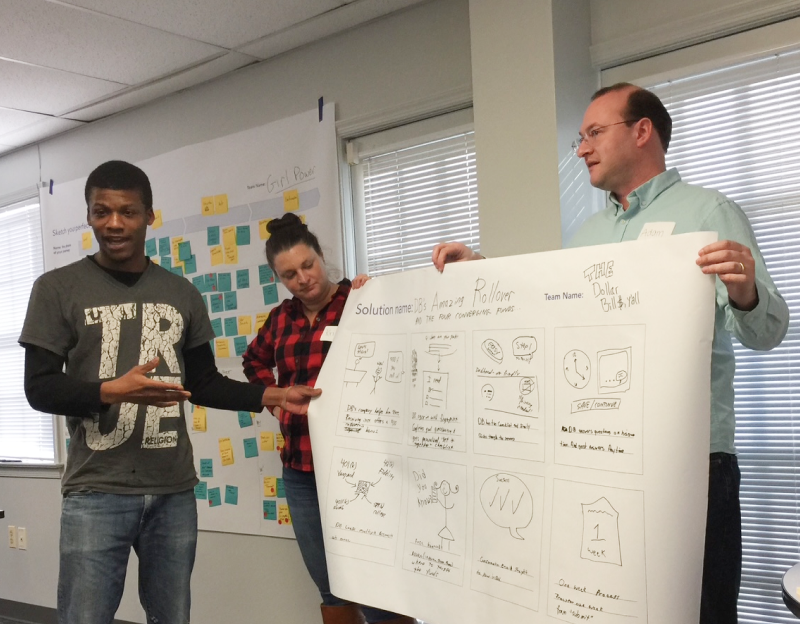
I established the research foundation through journey workshops, stakeholder interviews, and synthesis of operational data and customer feedback with cross-functional partners. From there, I led ideation, design execution, and user testing — partnering closely with product and engineering to define scope, align on priorities, and deliver the MVP.

I also extended the impact beyond the project by publishing research insights across the organization and creating an ideation workshop playbook to support other innovation teams.

Problem

Retirement distribution is one of the most consequential financial decisions a participant can make — yet the system relied on persuasion at the point of execution.

Before this project, distributions were handled entirely through a paper-based process supported by customer service and multiple manual checkpoints. Completing a request often required several touchpoints and could take weeks — creating high operational cost for the business and a slow, fragmented experience for users.

The process itself worked. The strategy did not.

By the time users initiated a distribution, most had already made a highly considered decision. Attempts to redirect that decision during a single interaction rarely changed outcomes. Users proceeded with withdrawals — often incurring significant financial loss — while the business failed to retain assets despite the effort.

At the same time, critical financial implications were often understood too late. While users expected taxes and penalties, the full impact — including fees and the loss of future compounding — remained abstract until the moment of action, when it was difficult to reconsider.

The tension wasn’t just strategic — it was human.

For many participants, especially those taking early distributions, the experience carried emotional weight. There was often hesitation, and in some cases, a sense of shame in needing to access retirement savings early. Being required to call and justify that decision added friction at a moment when users wanted autonomy and control.

The system asked customer service to both inform and persuade, placing them in the position of working against user intent. It asked users to navigate a complex, high-stakes decision without clear visibility into its full consequences. And it asked the business to retain assets through a model that rarely influenced outcomes.

What was missing wasn’t guidance — it was a better way to align user intent, financial understanding, and business goals within the experience itself.

Insight from User Research
Users have specific goals they are seeking to accomplish through distribution.
Users often are not aware of rules and fees associated with their distributions.
Users are concerned about the repercussion of taking distributions.
An average distribution process can take 2-3 weeks.
UX Strategy

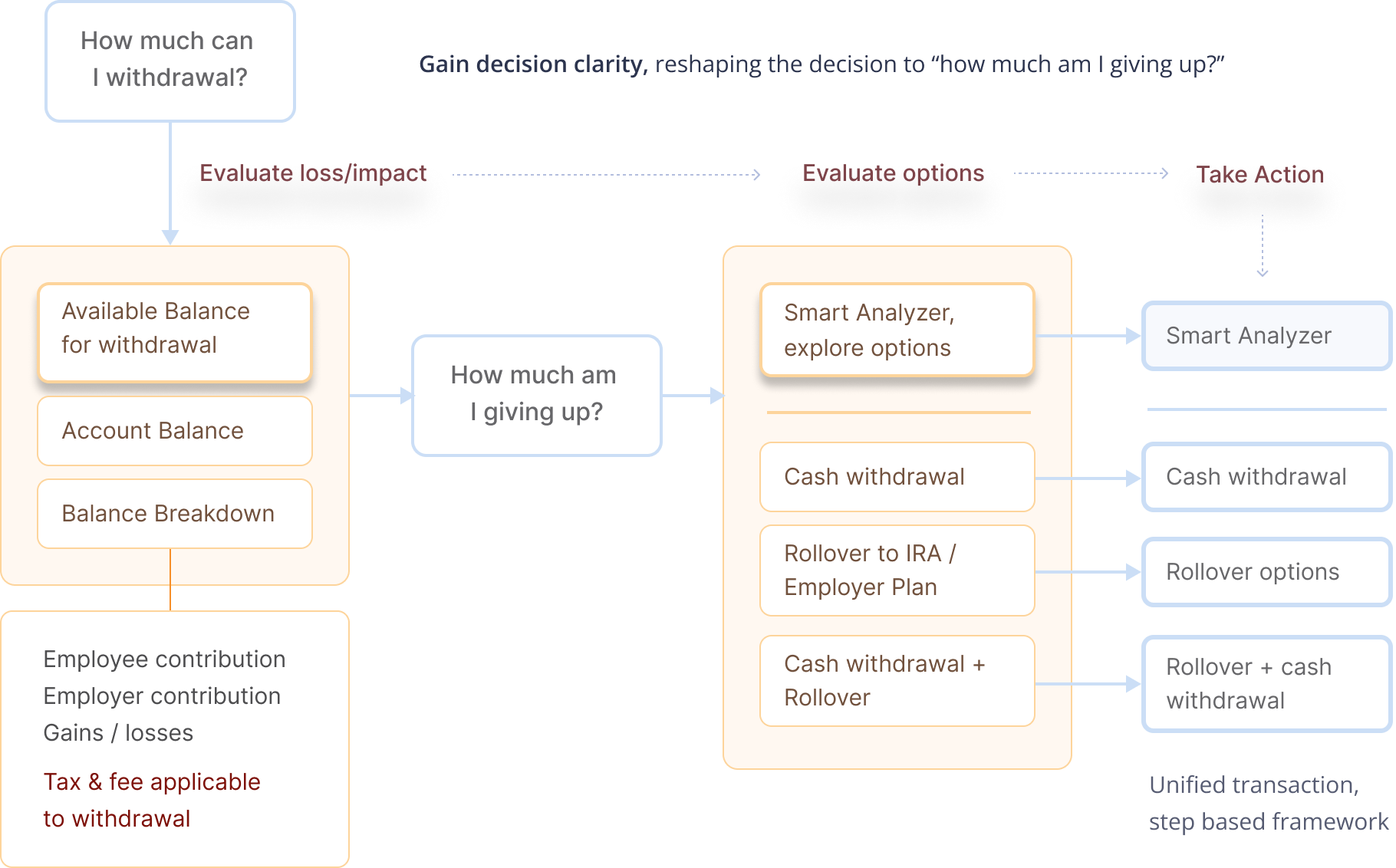
The design strategy centered on a single question: how do we help users make a well-informed decision without obstructing their ability to act? This reframed distribution from a transactional workflow into a decision-support system.

Moving distribution online wasn’t just a channel shift — it created an opportunity to reduce operational cost and processing time, enable access to distribution information at any time, and make financial implications clearer earlier in the decision. The system doesn’t just enable action — it improves the timing and clarity of understanding.

At its core, the experience shifts the user’s mindset:
not “how much can I take?” — but “what am I giving up?”

Phase 1 — Discover
We grounded the strategy in direct user research — combining journey mapping, in-depth interviews, operational data, and a competitive review.Rather than revealing best practices, the research exposed a gap — and three insights that shaped the experience:
The teachable moment
Users weren’t resistant to reconsidering their decision — they lacked visibility into the full financial impact. When that impact became clear, some users naturally explored better alternatives.
Empowerment through transparency
Users approached distribution as a deliberate decision. They didn’t want persuasion — they wanted clarity, control, and confidence at every step.
The need for visibility during waiting
Users weren’t just anxious about the decision — they were anxious about what happened after. They wanted to see where their money was and what remained before completion.
Phase 2 — Define
The strategy resolved into two complementary tracks:
Inform before commitment
Create a moment of clarity before the transaction — where users can understand implications, evaluate options, and confirm their decision with full context.
Execute with speed and clarity
Once a decision is made, remove friction. The transaction should be fast, transparent, and predictable — a guided, checkout-style flow that respects user intent and reduces dependency on manual processing.
Deicison Architecture
Guiding principle: a custodial mindset
T. Rowe Price has a responsibility to inform without obstructing. The experience creates space for reflection without introducing barriers — supporting both users who need to proceed and those who benefit from reconsideration.
The MVP focused on terminated participants — representing 60% of distribution costs — to maximize impact while validating the model.
Phase 3 — Design
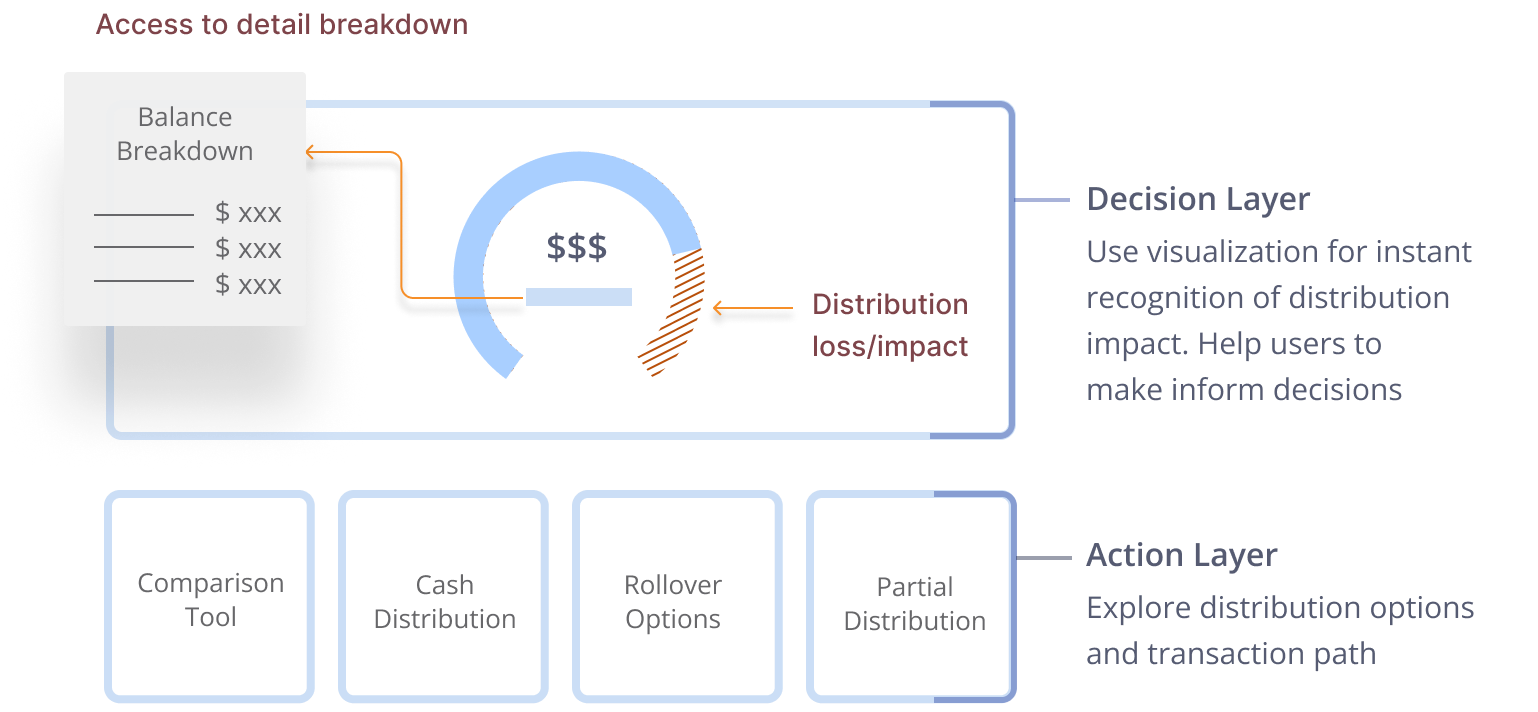
The strategy translated into a system of connected experiences:
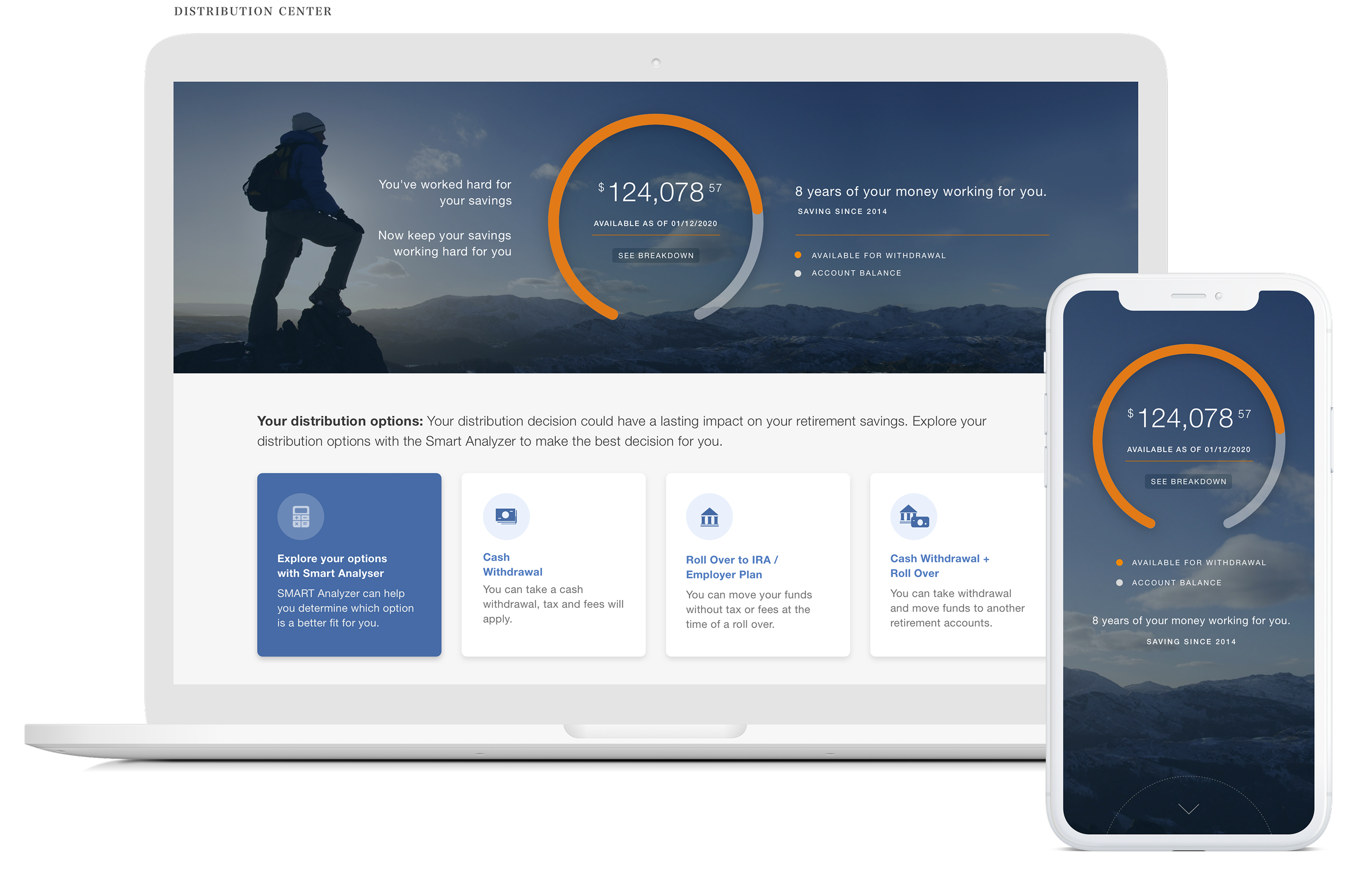
Distribution Center (decision layer)
An informed entry point that helps users understand their options, assess trade-offs, and make a confident decision before entering the transaction.
Transaction flow (execution layer)
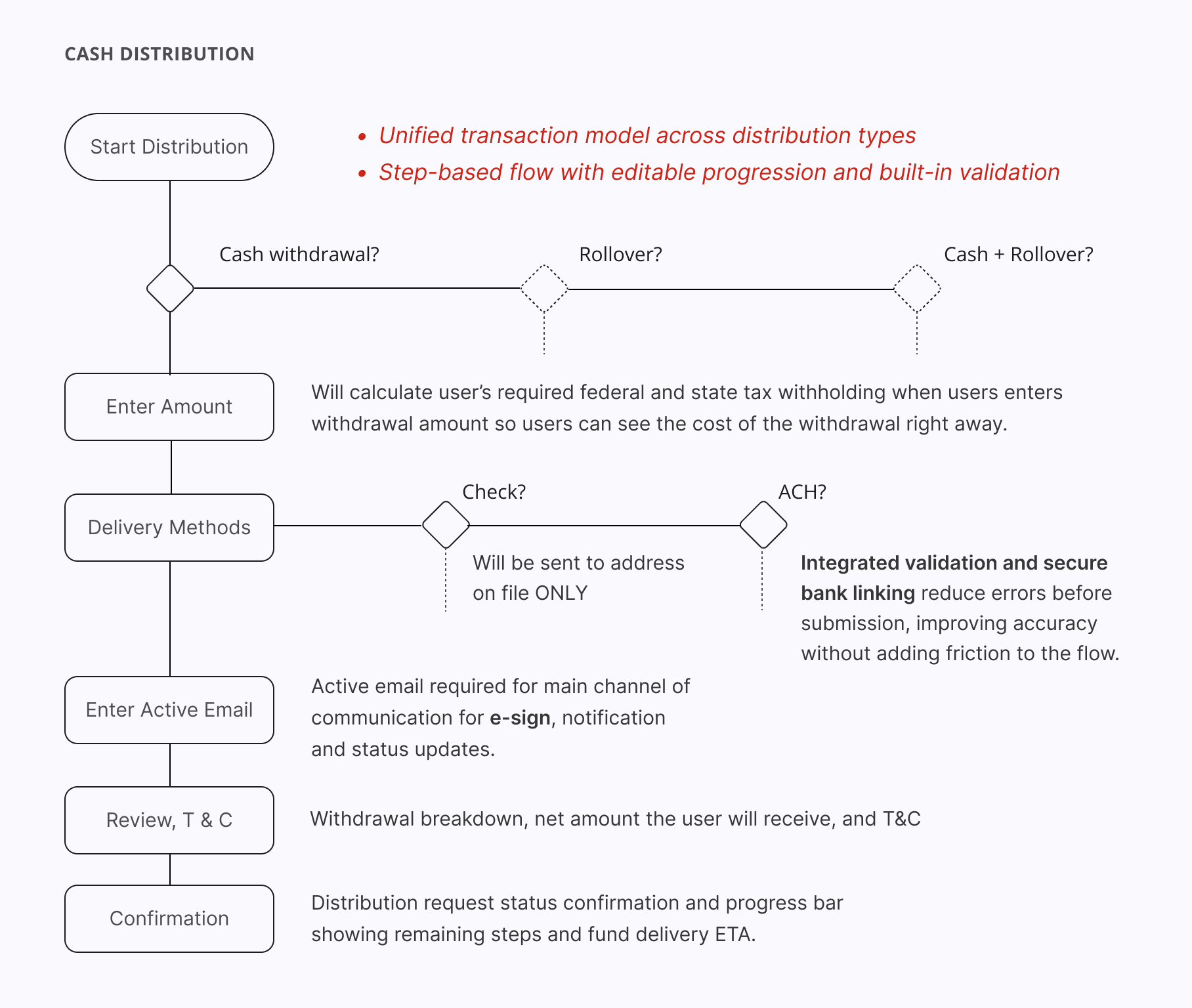
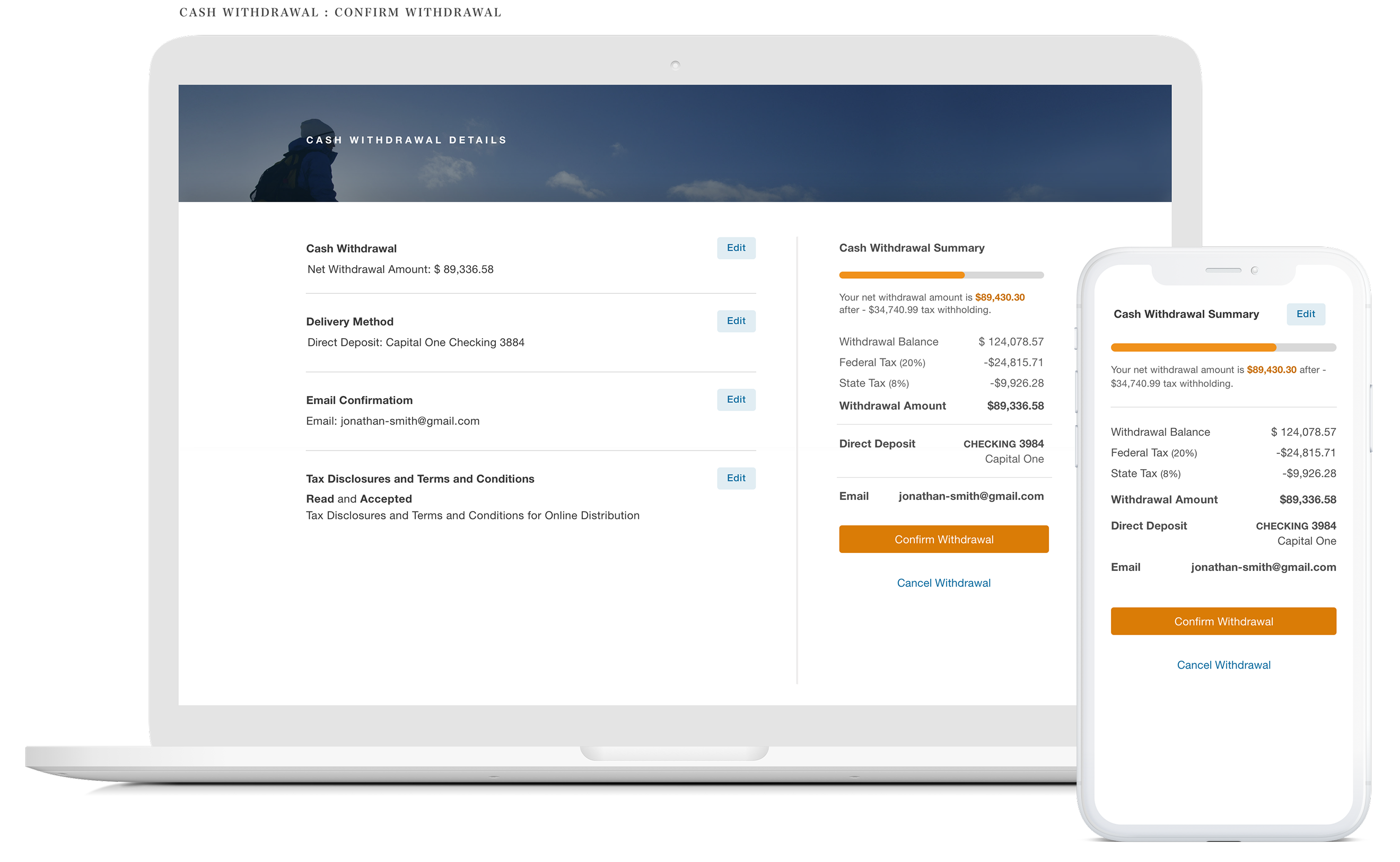
A linear, checkout-style flow designed for clarity and speed — with visible progress, editable steps, and predictable outcomes. Digital inputs, validation, and e-signature replaced manual steps, reducing processing time by over a week.
Post-submission visibility
A confirmation experience that provides timeline expectations and progress tracking — reducing uncertainty during the 1-2 week fulfillment period (ACH 1 week, Check 2 weeks).
Final Solution

The redesigned distribution experience was built around a single principle: meet users where they are — informed, determined, and deserving of clarity at every step.The solution resolves into two connected experiences: a Distribution Center that supports decision-making before the transaction, and a transaction flow that enables fast, confident execution.Together, these experiences shift distribution from a transactional flow into a decision-support system.

Distribution Center

This reframes the decision from “how much can I take?” to “what am I giving up?”

The Distribution Center serves as the informed entry point — giving users the context they need to make a confident decision before entering the transaction.

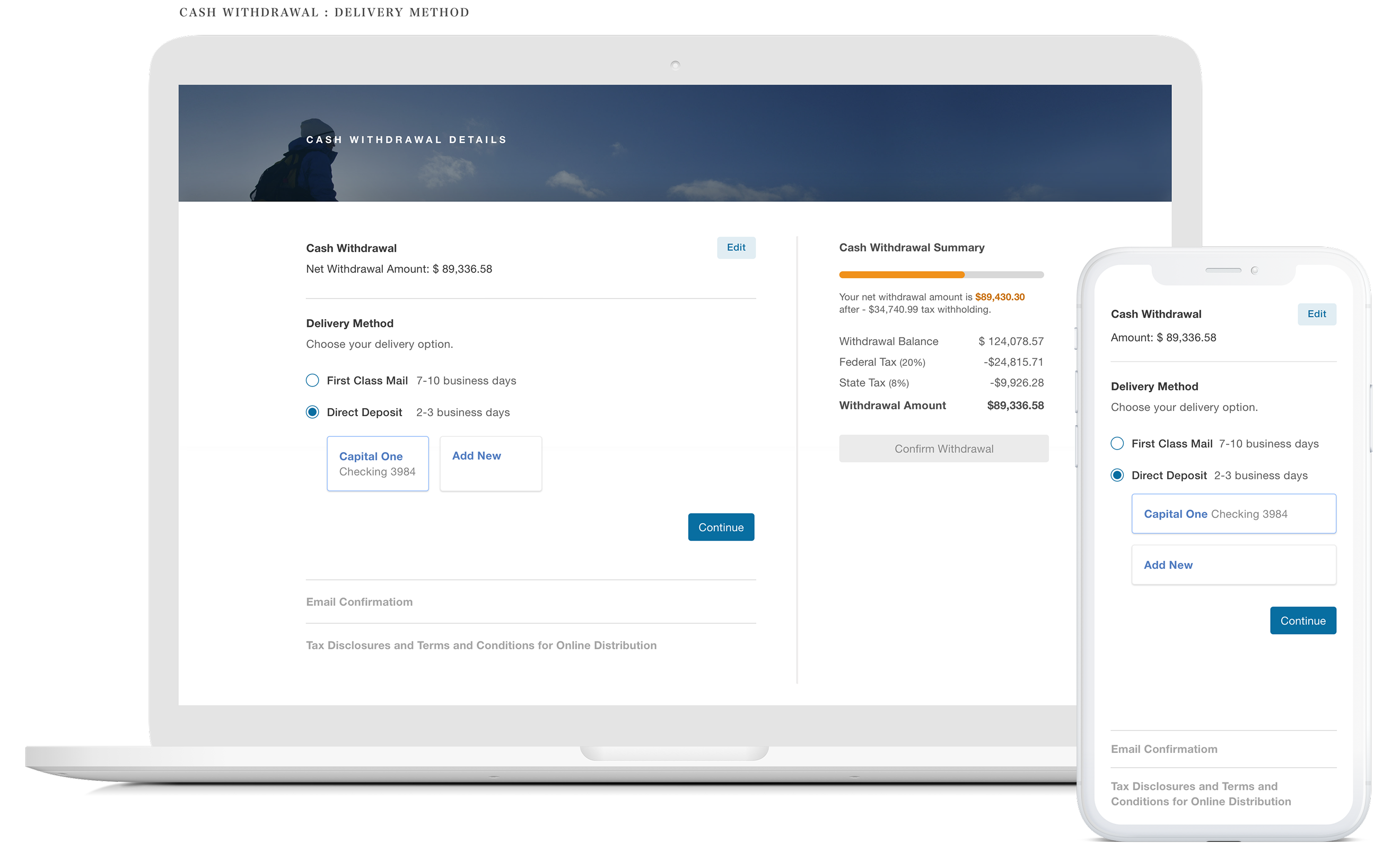
Transaction Flow

Once a decision is made, the experience gets out of the way.

The transaction flow follows a familiar, checkout-style model — linear, guided, and transparent. A unified transaction structure allows users to review and modify inputs at any step, balancing guidance with control. Users can see their progress, review and edit inputs at any step, and move forward with confidence. Distribution options include check or direct deposit, supported by secure bank linking and validation to ensure accuracy before submission.

Confirmation Experience

The experience extends beyond submission to remove uncertainty during fulfillment.

A confirmation page provides a clear timeline for the 1–2 week process and a progress indicator showing remaining steps — giving users visibility into what’s happening and what comes next. This transforms an otherwise opaque waiting period into one that feels finite, trackable, and predictable.

Results & IMpact

The distribution MVP launched on time and validated the model — users engaged independently, and the business saw immediate operational impact.The Distribution Center drew strong early engagement, with users not only completing transactions but actively exploring their options — confirming the value of an informed entry point.Within days of launch, ~18% of traffic originated from mobile, validating cross-device usage for high-consideration financial decisions.

Significant gains across customer experience, operational efficiency, and cost:
91% reduction in average transaction cost
Directly addressed the $14M paper process at scale
68% reduction in operational inefficiencies
Shifted distribution from paper and phone to self-service
67% faster delivery
Delivered in ~4 months vs. typical 8–12 month timelines
28% increase in customer satisfaction
Driven by clarity at key decision moments